
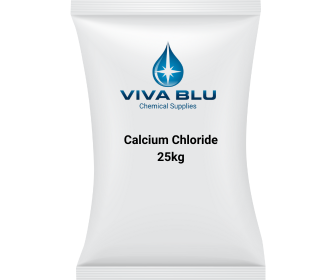
Calcium Chloride 25 kg – Premium Water Balance & Maintenance Solution
$74.00
Perfect for Pool Owners, Commercial Operators & Industrial Use
Keep your pool water crystal clear and perfectly balanced with Viva Blu Calcium Chloride (25 kg) – a high-purity, fast-acting solution designed to increase water hardness, protect surfaces, and prevent costly corrosion or scaling issues.
Trusted by pool professionals, resorts, and maintenance teams, Viva Blu’s formulation ensures consistent performance and reliable results every time.
Key Benefits
| Feature | Benefit |
|---|---|
| Increases Calcium Hardness | Prevents etching and surface damage in concrete or tiled pools |
| Reduces Corrosion Risk | Protects pool equipment, pipes, and fittings |
| Dissolves Rapidly | Fast-acting granules ensure quick results |
| Multi-Purpose Use | Ideal for pools, dust suppression, and industrial moisture control |
| Economical 25 kg Bag | Cost-effective and convenient for regular maintenance |
Recommended Applications
-
Swimming pools – maintain correct calcium hardness levels for balanced water
-
Dust control – stabilise unsealed roads, driveways, or construction sites
-
De-icing agent – effective in cold climates to prevent ice build-up
-
Industrial use – moisture control in manufacturing, warehousing, and packaging environments
Pool Dosing Instructions
| Pool Volume (Litres) | Desired Hardness Increase (ppm) | Calcium Chloride Required (kg) |
|---|---|---|
| 10,000 L | 50 ppm | 0.5 kg |
| 25,000 L | 50 ppm | 1.25 kg |
| 50,000 L | 50 ppm | 2.5 kg |
| 100,000 L | 50 ppm | 5.0 kg |
Tip: Always test calcium hardness before dosing. Ideal range for pools: 200 – 400 ppm.
Dissolve the required amount in a bucket of water and add slowly around the pool perimeter with the pump running.
Safety & Handling
-
Always wear gloves and eye protection when handling chemicals
-
Store in a cool, dry location away from moisture
-
Avoid mixing with other pool chemicals
-
Keep out of reach of children and pets
Product Specifications
| Parameter | Detail |
|---|---|
| Chemical Name | Calcium Chloride (CaCl) |
| Form | White Flake / Granular |
| Purity | 94 % |
| Pack Size | 25 kg bag |
| Solubility | Fully soluble in water |
| Shelf Life | 24 months (sealed and dry) |
Technical Reference
Technical Specifications
| Property | Detail |
|---|---|
| Chemical Name | Calcium Chloride |
| IUPAC Name | Calcium dichloride |
| Common Names | Calcium chloride flakes; pool hardener; cal chloride; road salt; CaCl₂ |
| Molecular Formula | CaCl₂ (anhydrous) / CaCl₂·2H₂O (dihydrate) |
| Molecular Weight | 110.98 g/mol (anhydrous); 147.01 g/mol (dihydrate) |
| CAS Number | 10043-52-4 (anhydrous); 10035-04-8 (dihydrate) |
| Concentration / Grade | ≥77% w/w (dihydrate flake/granule, technical/pool grade); anhydrous grades typically ≥94% w/w |
| Physical State | Solid (granule, flake, or prilled) |
| Appearance | White to off-white hygroscopic granules or flakes |
| Odour | Odourless |
| Bulk Density | Approximately 0.80–0.96 kg/L (granule); product-specific — refer to SDS |
| pH of Solution | 8.0–9.5 (10% w/v aqueous solution at 25°C) |
| Solubility in Water | 745 g/L at 20°C (highly soluble; exothermic dissolution) |
| Melting Point | 772°C (anhydrous); 176°C (dihydrate) |
| Hygroscopicity | Strongly hygroscopic — absorbs moisture readily from atmosphere |
| UN Number | Not classified as a dangerous good for transport in solid form at this concentration under the ADG Code (7th Edition). Refer to SDS for confirmation of current classification. |
| ADG Class | Not classified as dangerous goods (solid, non-hazardous for transport purposes). Concentrated aqueous solutions may attract classification — refer to current SDS. |
Applications & Use Cases
- Swimming pool calcium hardness adjustment: Raising calcium hardness (CH) in residential and commercial pools, spas, and water parks to the recommended range of 200–400 mg/L (ppm), in accordance with SPASA Australia guidelines.
- Surface protection in concrete and plaster pools: Preventing aggressive water from etching, pitting, or dissolving cementitious pool surfaces by maintaining a positive Langelier Saturation Index (LSI).
- Spa and hydrotherapy pool water balance: Maintaining appropriate hardness levels in high-temperature spa environments (typically 150–250 mg/L CH) where evaporation and dilution create more rapid hardness fluctuation.
- Dust suppression on unsealed roads, mine haul roads, and construction sites: Applied as an aqueous solution to suppress fugitive dust by absorbing atmospheric moisture and binding fine particles to the road surface.
- Concrete set acceleration: Used as a concrete admixture to accelerate the hydration of Portland cement in cold-weather concreting operations.
- Refrigeration brine: Used as a low-freezing-point brine solution in indirect refrigeration systems and ice rinks.
- Desiccation and moisture control: Industrial drying and moisture absorption in enclosed environments, shipping containers, and storage facilities.
- Food processing: Food-grade calcium chloride is used as a firming agent (INS 509), in cheese manufacture, and in electrolyte formulations. Note: food-grade specification must be confirmed separately — pool/technical grade is NOT suitable for food applications.
- Oil and gas drilling fluids: Calcium chloride brine used as a completion and workover fluid to control formation pressure.
- Aquaculture and aquarium water hardness adjustment: Raising general hardness (GH) in freshwater aquaculture systems and display aquaria.
- Water treatment — calcium supplementation: Adding calcium to treated potable water to prevent corrosion of distribution infrastructure, subject to compliance with Australian Drinking Water Guidelines (ADWG) and AS/NZS 4020.
Dosing Rates & Guidelines
Dosing rates are indicative based on standard Australian industry practice. Site-specific water chemistry, existing calcium hardness, total dissolved solids, temperature, and pool volume must be assessed before dosing. Always test water before and after treatment.
| Application | Minimum Effective Dose | Typical Dose | Maximum Single Dose | Units | Notes |
|---|---|---|---|---|---|
| Pool — raise CH by 10 mg/L (ppm) | — | 13–14 | — | g/m³ (per 10 ppm CH rise) | Based on 77% dihydrate flake. Exact addition = (desired rise in ppm × pool volume in m³ × 0.135). Retest after 4–6 hours circulation before re-dosing. |
| Pool — target CH 200–400 mg/L (residential) | 200 | 250–350 | 400 | mg/L (ppm) | SPASA recommended range. Do not dose to exceed 400 ppm CH in a single treatment event — dose in stages of no more than 100 ppm increase per 24 hours. |
| Pool — target CH (commercial / resort) | 200 | 250–300 | 350 | mg/L (ppm) | Lower upper limit recommended for commercial pools with higher bather loads. Monitor LSI daily. |
| Spa / hydrotherapy pool | 150 | 175–250 | 275 | mg/L (ppm) | Lower target due to elevated water temperature (28–40°C) shifting LSI. More frequent testing required — weekly minimum. |
| Dust suppression — initial treatment (unsealed road) | 0.5 | 1.0–1.5 | 2.0 | L/m² (applied as 30–35% aqueous solution) | Initial penetrating application. Dilute solid product to 30–35% w/v solution. Apply by pressure tanker with spray bar. Multiple passes may be required. |
| Dust suppression — maintenance application | 0.2 | 0.3–0.5 | 0.8 | L/m² (applied as 30–35% aqueous solution) | Interval and rate depend on traffic volume, rainfall, and surface condition. Reassess every 4–8 weeks in dry conditions. |
| Concrete set acceleration | 0.5 | 1.0–2.0 | 2.0 | % w/w of cement mass | Do not exceed 2% w/w of cement content (anhydrous equivalent). Compliance with AS 1478.1 (chemical admixtures) required. Not for use in reinforced concrete (chloride-induced corrosion risk). |
| Refrigeration brine | 20 | 25–30 | 40 | % w/v aqueous solution | Freeze point of 25% solution ≈ −18°C; 30% solution ≈ −25°C. Use inhibited grade or add corrosion inhibitor for metal system protection. Design to system operating temperature. |
Dilution Instructions
General Dissolution Principles
- Calcium chloride dissolution is strongly exothermic — the solution will become hot during mixing. This is normal and expected. Avoid contact with hot solution.
- Never add water to solid calcium chloride in a sealed or restricted container — heat and pressure build-up can cause splashing or container failure.
- Always add solid calcium chloride to water (not water to solid) when preparing concentrated solutions.
- Use only clean, potable or process water free of high phosphate, carbonate, or sulphate levels to avoid precipitation of insoluble calcium salts during dissolution.
Pool Water Hardness Adjustment — Pre-Dissolving Method (Recommended)
- Put on full PPE before handling: chemical splash goggles, nitrile or PVC gloves (minimum 0.3 mm), and chemical-resistant apron.
- Calculate the required dose using the formula: Mass (kg) = (Target CH − Current CH) × Pool Volume (m³) × 0.00135 for 77% dihydrate product. Example: raising CH by 50 ppm in a 50 m³ pool requires approximately 3.4 kg of product.
- Fill a clean, non-metallic bucket (20 L minimum capacity, HDPE preferred) with approximately 10 litres of clean pool water or tap water at ambient temperature.
- Slowly add the pre-weighed calcium chloride to the water in small increments while stirring continuously with a non-metallic paddle or rod.
- Allow the solution to cool to ambient temperature (allow 10–15 minutes) before application to the pool.
- With the pool pump and filtration system running at full circulation, slowly pour the cooled solution into the pool in front of a return jet or into the deep end, distributing it around the perimeter. Do not pour directly onto pool surfaces, vinyl liners, or adjacent to steps.
- Allow the system to circulate for a minimum of 4–6 hours before retesting calcium hardness.
- Do not re-dose until testing confirms the first addition has been fully distributed. Do not increase CH by more than 100 mg/L in any 24-hour period.
- Dispose of the empty bucket contents by diluting into the pool or waste collection — do not pour concentrated solution onto garden beds, lawn, or into stormwater drains.
Direct Pool Addition Method (Alternative — Granule Application)
- This method is suitable only for small doses (less than 500 g per application in pools greater than 50 m³) and is not recommended for vinyl-lined or fibreglass pools.
- Ensure pool pump is running at full circulation.
- Broadcast granules evenly across the pool surface in the deep end, distributing while walking around the pool edge. Do not concentrate the dose in one spot.
- Do not allow swimmers to re-enter the pool until the granules have fully dissolved and water has circulated for a minimum of 4 hours.
- Retest after circulation — if white residue or cloudiness persists after 6 hours, check pH and total alkalinity, as excessive carbonate hardness may cause calcium carbonate precipitation.
Dust Suppression Solution Preparation (30–35% w/v)
- Use a 1,000 L or larger HDPE IBC or purpose-built chemical mixing tank with a mechanical agitator. Ensure the tank is rated for corrosive solutions.
- Fill the mixing tank to 60% of target volume with clean water.
- Start the agitator or recirculation pump.
- Slowly add calcium chloride solid to the circulating water. For a 30% w/v solution in 1,000 L: add approximately 300 kg of product to approximately 700 L of water. Adjust for 77% grade product accordingly (300 kg ÷ 0.77 ≈ 390 kg of 77% product).
- Monitor solution temperature — allow to cool before transfer. Do not exceed 50°C during preparation.
- Top up to final volume with water once dissolution is complete. Stir for a further 10 minutes.
- Transfer to application tanker via chemical-rated pump and hose. Label clearly with contents, concentration, and date of preparation.
Chemical Compatibility
Compatible With
- Water (all temperatures — note exothermic dissolution)
- Most pool sanitisers at correct dilution (chlorine, bromine, TCCA — when separately applied and not mixed in dry form)
- HDPE, polypropylene, PVC, PVDF, fibreglass, and rubber — suitable for storage and handling equipment
- Stainless steel 316L and 304 for brief contact; not recommended for prolonged immersion in concentrated solutions without corrosion inhibitor
- Concrete and masonry (dilute, applied solutions)
Incompatible With — Do NOT Mix
| Weight | 25 kg |
|---|---|
| Dimensions | 58 × 42 × 20 cm |
Related products
-
Nitric Acid 68%
Price range: $62.00 through $169.00 Select options This product has multiple variants. The options may be chosen on the product page


