
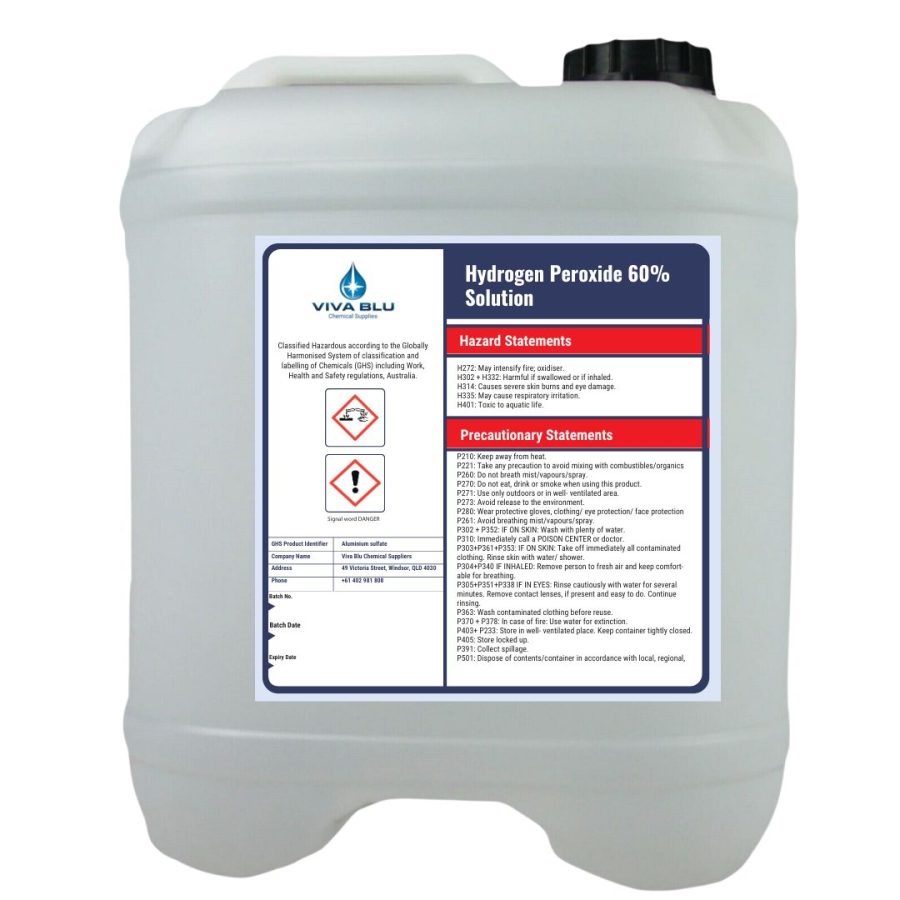
Key Features of Our Hydrogen Peroxide 50%:
- Concentration: 50% w/w (high-strength, stabilised for extended shelf life)
- Purity: Technical/industrial grade, clear and colourless
- Eco-Friendly: Breaks down into H2O and O2 no harmful residues
- Multi-Purpose: Strong oxidiser for disinfection, bleaching, and chemical processes
- Stable Storage: Less than 1% decomposition per year when stored properly (cool, dark, vented area)
Important Safety Note: Hydrogen Peroxide 50% is a concentrated oxidiser and must be diluted before most uses. It is corrosive to skin, eyes, and mucous membranes. Always wear PPE (gloves, goggles, protective clothing), work in a well-ventilated area, and follow SDS guidelines. Not for direct human or animal contact without dilution. Professional/industrial use recommended.
Common Applications of 50% Hydrogen Peroxide: high-concentration H2O2 is widely used in:
- Water and wastewater treatment (odour control, disinfection)
- Aquaculture and pond management (oxygenation, algae/parasite control)
- Hydroponics and gardening (root zone oxygenation, disease prevention)
- Industrial cleaning and surface sanitisation
- Textile/paper bleaching and stain removal
- Mining and chemical processing
Recommended Dosing Rates and Dilution Guidelines 50% hydrogen peroxide is never used undiluted for most applications. Always dilute with clean (preferably distilled) water and test small areas first. Below are general dosing tables for popular use cases, based on industry standards and safe practices. Dosages are approximate; adjust accordingly based on specific conditions and consult experts for large-scale use.
1. Aquaculture & Pond Water Treatment (Algae Control, Oxygenation, Parasite Treatment)
|
Application
|
Target Concentration
|
Amount of 50% H2O2 per 1,000 Litres (264 Gallons) of Water
|
Notes
|
|---|---|---|---|
|
General oxygenation
|
0.25-0.5% (2,500-5,000 ppm)
|
500-1,000 mL
|
For low oxygen levels, apply slowly
|
|
Algae/parasite control
|
0.05-0.1% (500-1,000 ppm)
|
100-200 mL
|
Short-term treatment; monitor fish stress
|
|
Severe infections (e.g., fungus)
|
Up to 0.2% (2,000 ppm)
|
Up to 400 mL
|
Use with caution; aerate heavily
|
2. Hydroponics & Plant Root Zone Treatment (Root Rot Prevention, Oxygen Boost)
|
Application
|
Target Concentration
|
Amount of 50% H2O2 per 10 Litres (2.6 Gallons) Nutrient Solution
|
Notes
|
|---|---|---|---|
|
Preventive oxygenation
|
0.01-0.03% (100-300 ppm)
|
2-6 mL
|
Add weekly or as needed
|
|
Mild root rot treatment
|
0.05% (500 ppm)
|
10 mL
|
Short exposure (1-2 hours), then flush
|
|
Strong sterilization
|
0.1-0.2% (1,000-2,000 ppm)
|
20-40 mL
|
For system cleaning (no plants present)
|
3. Surface Disinfection & Cleaning (Industrial/Commercial)
|
Application
|
Target Concentration
|
Dilution Ratio (50% H2O2: Water)
|
Notes
|
|---|---|---|---|
|
General sanitizing
|
3-6%
|
1:16 to 1:8
|
Spray/wipe; effective against bacteria/viruses
|
|
Heavy-duty mould/mildew removal
|
6-10%
|
1:8 to 1:5
|
Apply, let sit 10-15 min, rinse
|
|
Equipment sterilization
|
6-35%
|
1:8 to undiluted (for non-contact)
|
Food-grade surfaces; rinse thoroughly
|
Quick Dilution Tip: To make 3% H2O2 (common household strength): Mix 1 part 50% H2O2 with ~16 parts water.
4. Water Treatment & Odour Control (Municipal/Industrial)
|
Application
|
Typical Dosage
|
Amount of 50% H2O2 per 1,000 Litres of Water
|
Notes
|
|---|---|---|---|
|
Odour control (H2S removal)
|
1-5 ppm active O2
|
5-25 mL
|
Inject upstream; monitor residuals
|
|
Disinfection/oxidation
|
10-50 ppm H2O2
|
20-100 mL
|
Alternative to chlorine
|
For precise calculations or custom applications, use our free dilution calculator or contact our team. Why Buy Hydrogen Peroxide 50% From Us?
- Competitive bulk pricing
- Fast, secure shipping worldwide
- Expert support for safe handling and usage
- High-quality, stabilised formula for longer shelf life
Order your 50% hydrogen peroxide today and experience the power of concentrated H2O2! For quotes on larger quantities or technical data sheets, reach out now.
Technical Reference
Technical Specifications
| Property | Detail |
|---|---|
| Chemical Name | Hydrogen Peroxide |
| IUPAC Name | Oxidanyl |
| Common Names | H2O2, Hydrogen Dioxide, Peroxide, Oxygenated Water |
| Molecular Formula | H₂O₂ |
| Molecular Weight | 34.01 g/mol |
| CAS Number | 7722-84-1 |
| Concentration / Grade | 50% w/w, Technical Grade |
| Physical State | Liquid |
| Appearance | Clear, colourless liquid |
| Odour | Slightly sharp, characteristic odour |
| Density | Approximately 1.195 g/mL at 20°C |
| pH (of solution) | 1.0–2.0 (neat, 50% solution at 20°C) |
| Boiling Point | 114°C (50% aqueous solution) |
| Freezing Point | Approximately −52°C (50% aqueous solution) |
| Vapour Pressure | Approximately 9.9 hPa at 20°C |
| Solubility | Completely miscible with water in all proportions |
| Stabilisers | Low-level phosphate or stannate stabilisers (technical grade); confirm specification with SDS |
| UN Number | UN 2014 |
| ADG Class | Class 5.1 (Oxidising Agent) with Subsidiary Risk 8 (Corrosive) |
| Packing Group | II |
| Hazchem Code | 2X |
Applications & Use Cases
- Water & Wastewater Treatment: Oxidation of dissolved iron, manganese, hydrogen sulphide, and organic contaminants in potable water and industrial effluent streams; control of biological oxygen demand (BOD) and chemical oxygen demand (COD).
- Cooling Tower Disinfection: Periodic or continuous dosing for control of Legionella spp., biofilm, and algae in open recirculating cooling water systems, in accordance with AS/NZS 3666 guidelines.
- Swimming Pool & Spa Sanitation: Alternative to chlorine-based sanitisers for pools operated on peroxide-based programmes (typically in combination with copper/silver ionisation or UV systems); shock dosing for algae and organic load control.
- Aquaculture: Treatment of ectoparasites including sea lice (Caligus spp., Lepeophtheirus spp.) in marine and freshwater finfish production; oxygenation of high-density aquaculture systems.
- Hydroponics & Horticulture: Root zone oxygenation, pathogen suppression (Pythium spp., Fusarium spp.), and nutrient solution disinfection in recirculating hydroponic systems.
- Food & Beverage Processing: CIP (Clean-in-Place) circuit disinfection; aseptic packaging sterilisation (Tetra Pak and similar systems); surface sanitation on food contact materials (food-grade grade H2O2 required for direct food contact applications).
- Textile & Pulp Bleaching: Cellulose fibre brightening and bleaching as a chlorine-free alternative in textile, paper, and pulp manufacturing operations.
- Industrial Surface Cleaning & Decontamination: Biodecontamination of cleanrooms, pharmaceutical manufacturing environments, and laboratory spaces; mould and microbial remediation on hard surfaces.
- Chemical Synthesis & Manufacturing: Epoxidation, hydroxylation, and other oxidation reactions as a clean oxidant in organic synthesis; production of sodium percarbonate, peracetic acid, and other peroxide-derived chemicals.
- Mining & Mineral Processing: Cyanide detoxification in tailings dams; leaching oxidant in gold extraction circuits; treatment of acid mine drainage.
- Soil & Groundwater Remediation: In-situ chemical oxidation (ISCO) of petroleum hydrocarbons, BTEX, chlorinated solvents, and other organic contaminants (commonly catalysed via Fenton’s reagent with ferrous sulphate).
- Odour Control: Oxidation of hydrogen sulphide and mercaptans in wastewater collection systems, pump stations, and industrial exhaust scrubbers.
- Electronics & Precision Cleaning: Microelectronics substrate cleaning (Piranha solution with sulphuric acid — specialist use only); PCB manufacture and cleaning applications.
Dosing Rates & Guidelines
All dosing rates below are indicative based on standard Australian industry practice. Actual rates must be verified by site-specific jar testing, process analysis, or qualified advice. Dosing is concentration-dependent — the rates below apply to 50% w/w hydrogen peroxide unless otherwise stated.
| Application | Minimum Effective Dose | Maximum Safe / Typical Upper Dose | Units | Notes & Conditions |
|---|---|---|---|---|
| Potable water treatment (iron/Mn oxidation) | 0.5 | 5.0 | mg H₂O₂/L (as active) | pH 6.5–8.5; contact time ≥ 10 min before filtration; residual H₂O₂ must be removed prior to distribution. Confirm with water authority. Not approved for all potable applications — verify with AS/NZS 4020. |
| Wastewater / effluent oxidation (H₂S removal) | 2.0 | 10.0 | mg H₂O₂/L per mg/L H₂S | Typical ratio: 2–4 mg H₂O₂ per mg/L H₂S; higher organic loads require increased dose. Continuous metering preferred. |
| Cooling tower disinfection (Legionella control) | 50 | 200 | mg/L (as active H₂O₂) | Shock dose: 100–200 mg/L; maintenance residual: 50–80 mg/L. Contact time ≥ 30 min. Reference AS/NZS 3666.2. Confirm compatibility with metallurgy (especially copper alloys) before use. |
| Swimming pool — shock / oxidation dose | 50 | 100 | mg/L (as active H₂O₂) | Equivalent to approximately 10–20 mL of 50% H₂O₂ per 1,000 L pool water. Do not use simultaneously with chlorine-based products. pH 7.0–7.6. Allow 24–48 hours before swimming if high dose applied. |
| Swimming pool — peroxide-based maintenance | 30 | 80 | mg/L (as active H₂O₂) | Maintain residual 30–50 mg/L in combination with ionisation or UV systems. Test with peroxide-specific test strips or photometric analyser; standard DPD chlorine tests are not compatible. |
| Aquaculture — sea lice / parasite bath treatment | 1,200 | 1,800 | mg/L (as active H₂O₂); 30-min bath | Dose is species- and temperature-dependent. Reduce dose at water temperatures > 14°C. Atlantic salmon: 1,500 mg/L standard; observe fish behaviour throughout. APVMA registration required for therapeutic use — confirm current registration status. Aerate tanks post-treatment. |
| Hydroponics — nutrient solution treatment | 0.3 | 3.0 | mL of 50% H₂O₂ per 10 L nutrient solution | For root zone oxygenation and pathogen suppression: 2–3 mL per 10 L. Avoid exceeding 50 mg/L active concentration in solution at plant root contact. Verify impact on beneficial microorganisms in organic systems. |
| Surface disinfection (hard surfaces) | 0.5% v/v | 3.0% v/v | % v/v (diluted working solution) | Dilute 50% H₂O₂ to working concentration (e.g., 1:17 dilution for 3% v/v working solution). Contact time: 5–30 min depending on target organism. Rinse food contact surfaces thoroughly post-application. |
| CIP circuit disinfection (food & beverage) | 0.5 | 2.0 | % v/v (working solution) | Food-grade H₂O₂ required for food contact applications. Contact time 20–30 min at ambient temperature; efficacy improves with heat (40–50°C). Confirm material compatibility with stainless steel grades, seals, and gaskets. |
| ISCO groundwater remediation (Fenton’s reagent) | 0.5 | 10 | % v/v (injected H₂O₂ solution) | Catalysed with ferrous sulphate (Fe²⁺); typical Fe:H₂O₂ molar ratio 1:5 to 1:20. Subsurface injection rate site-specific. Geotechnical and hydrogeological assessment required. Exothermic reaction — monitor subsurface temperature. |
| Cyanide detoxification (mining) | 1.5 | 5.0 | kg H₂O₂ (as 100%) per kg CN⁻ | Stoichiometric ratio: ~1.35 kg H₂O₂ per kg CN⁻ for oxidation to cyanate. Copper catalyst typically employed. Alkaline pH (10–11) preferred. Compliance with relevant state mine site environmental licence conditions required. |
Dilution Instructions
Important: Hydrogen peroxide 50% is a strong oxidising agent and a corrosive liquid. All dilution operations must be conducted by trained personnel wearing full PPE (see Safety & Handling section). Never add water to concentrated hydrogen peroxide — always add hydrogen peroxide to water.
- Equipment Required: HDPE, polypropylene (PP), or 316L stainless steel containers and dosing equipment; nitrile or neoprene gloves (minimum); chemical splash goggles; face shield; PVC apron or chemical-resistant coveralls; calibrated measuring jug or metering pump; eyewash station within 10 seconds travel.
- Order of Addition — Cardinal Rule: Always add the hydrogen peroxide to the water, never the reverse. Adding water to concentrated H₂O₂ can cause vigorous splashing and localised exothermic decomposition.
- Calculate the volume of 50% H₂O₂ required using the dilution formula: C₁V₁ = C₂V₂ — for example, to prepare 10 litres of a 3% working solution: V₁ = (3% × 10 L) / 50% = 0.6 L of 50% H₂O₂ added to 9.4 L of water.
- Fill the clean HDPE or PP dilution vessel with the required volume of clean, cold water first (≤ 20°C preferred). Use demineralised or low-conductivity water where possible; high concentrations of transition metal ions (iron, manganese, copper) in hard tap water can accelerate decomposition.
- Don all required PPE before handling the concentrated product. Inspect gloves and face shield for damage before use.
- Slowly and carefully measure the required volume of 50% H₂O₂ from the original container using a dedicated HDPE measuring vessel or calibrated metering pump. Never use metal scoops or contaminated utensils.
- Add the measured 50% H₂O₂ slowly to the water with gentle mixing. If mixing by hand, use a PP or
| Weight | 24 kg |
|---|---|
| Dimensions | 28 × 28 × 38 cm |
| Volume | 5L, 20L |
Related products
-
Sulphuric Acid 98%
Price range: $60.00 through $138.00 Select options This product has multiple variants. The options may be chosen on the product page


