
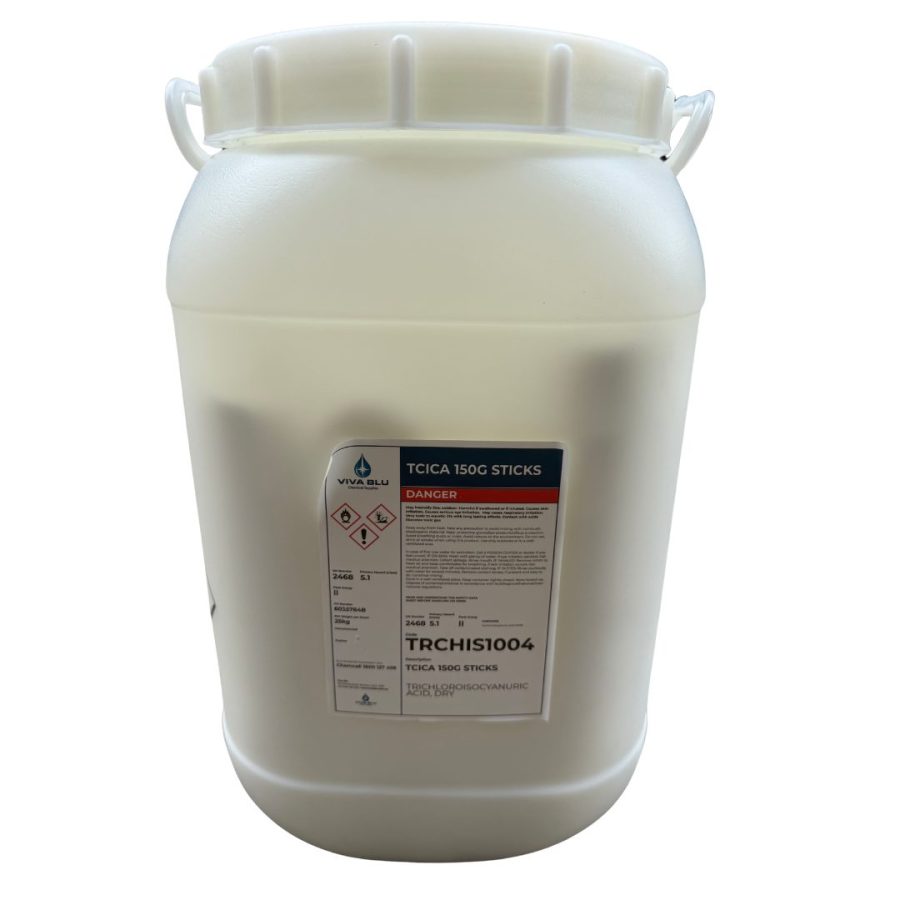
Viva Blu Stabilised Trichlor Tablets 25kg (150g Small Stick)
$198.00
Key Features & Benefits
- High-Potency 90% Available Chlorine — Rapidly destroys bacteria, pathogens, and organic contaminants
- Extended Slow-Release Action — Delivers chlorine steadily over several days to a week — ideal for “set and forget” applications
- UV-Stabilised Formula — Cyanuric acid protection maintains chlorine strength even in exposed or outdoor systems
- Low-Maintenance Design — 150g sticks reduce dosing frequency and labour compared to liquid or granular alternatives
- Versatile Application — Compatible with most tablet feeders, contact chambers, and gravity-feed systems
- Cost-Effective — Bulk strength and long dissolution time deliver excellent value in high-volume or continuous-use situations
Primary Applications
Trichlor Sticks are widely used across industrial, commercial, and water treatment scenarios:
- Septic Systems & On-Site Wastewater — Controls odours, reduces bacterial slime, and helps manage effluent quality
- Wastewater Treatment & Reuse — Disinfects treated effluent for irrigation, industrial reuse, or environmental discharge
- Industrial Process Water — Sanitises recirculating systems in manufacturing, food & beverage processing, and wash-down operations
- Cooling Towers & HVAC Systems — Controls microbial growth (including Legionella risk) in open and closed-loop cooling systems
- Potable Water Storage & Emergency Treatment — Treats tanks, cisterns, wells, and rainwater harvesting systems
- Other Uses — Drill rigs, remote camps, construction site water, remediation projects, and spill response
General Instructions for Safe & Effective UseMaintain appropriate free chlorine residuals based on your specific application (typically 0.5–5 ppm depending on purpose and regulations).
- Pre-Treatment Testing — Always test water quality (chlorine, pH, cyanuric acid) before dosing. Keep cyanuric acid below 50–100 ppm depending on system requirements.
- Dosing Guidance — Dosage varies widely by application, flow rate, and target residual. As a starting reference: 1 × 150g stick can treat approximately 15,000–25,000 litres depending on demand and contact time. Always calculate based on system volume, flow, and required chlorine residual.
- Placement — Use in purpose-designed tablet feeders, contact chambers, or gravity-feed erosion devices. Ensure good water flow across the sticks.
- Monitoring — Regularly measure free chlorine, pH, and system performance. Adjust stick quantity or feed rate as needed.
- Safety Precautions — Wear appropriate PPE (gloves, eye protection) when handling. Store in a cool, dry, well-ventilated area away from incompatible materials. Do not mix with other chemicals. In case of contact, rinse thoroughly and seek medical attention if irritation persists.
- Regulatory Note — Always follow local water treatment regulations, dosing guidelines, and discharge standards.
Need consistent, powerful disinfection for septic systems, wastewater, cooling towers, industrial processes or remote water treatment?
Technical Reference
Technical Specifications
| Property | Detail |
|---|---|
| Chemical name | Trichloroisocyanuric acid |
| IUPAC name | 1,3,5-trichloro-1,3,5-triazinane-2,4,6-trione |
| Common names | TCCA, trichlor, stabilised chlorine tablets/sticks, trichloroisocyanuric acid |
| Molecular formula | C₃Cl₃N₃O₃ |
| Molecular weight | 232.41 g/mol |
| CAS number | 87-90-1 |
| Available chlorine content | ≥90% w/w available chlorine |
| Cyanuric acid (stabiliser) content | Approx. 57% w/w (released upon dissolution) |
| Physical state | Solid (compressed tablet/stick form) |
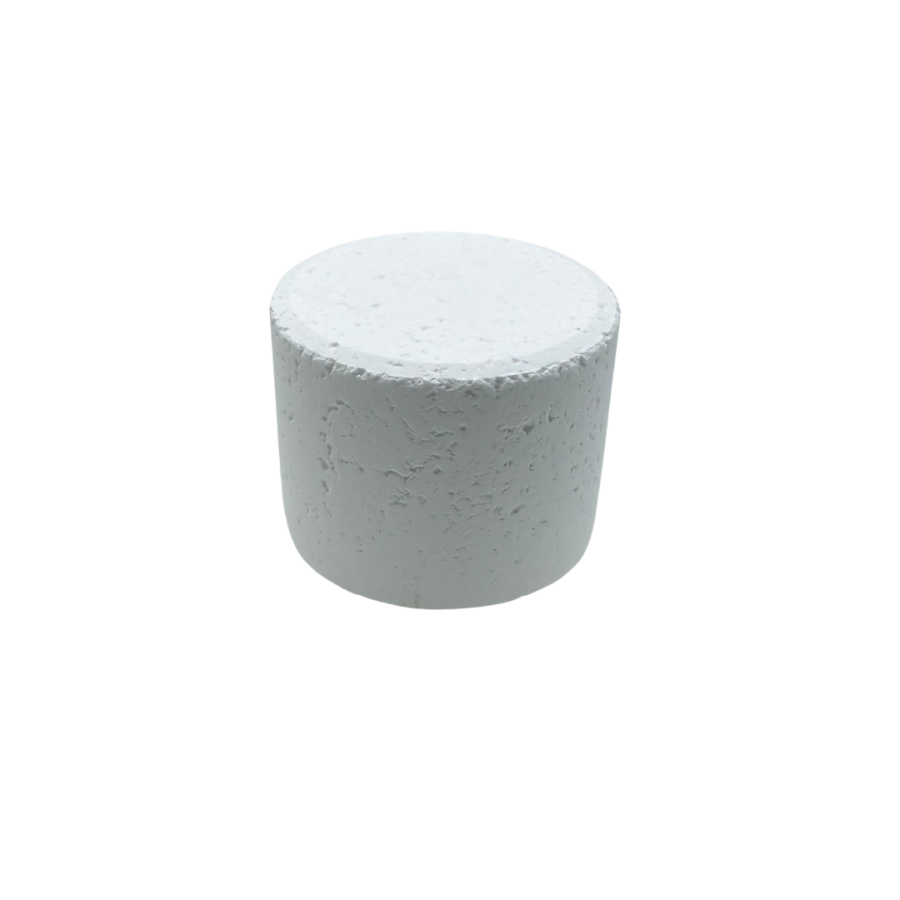
| Appearance | White to off-white compressed stick; characteristic chlorine odour |
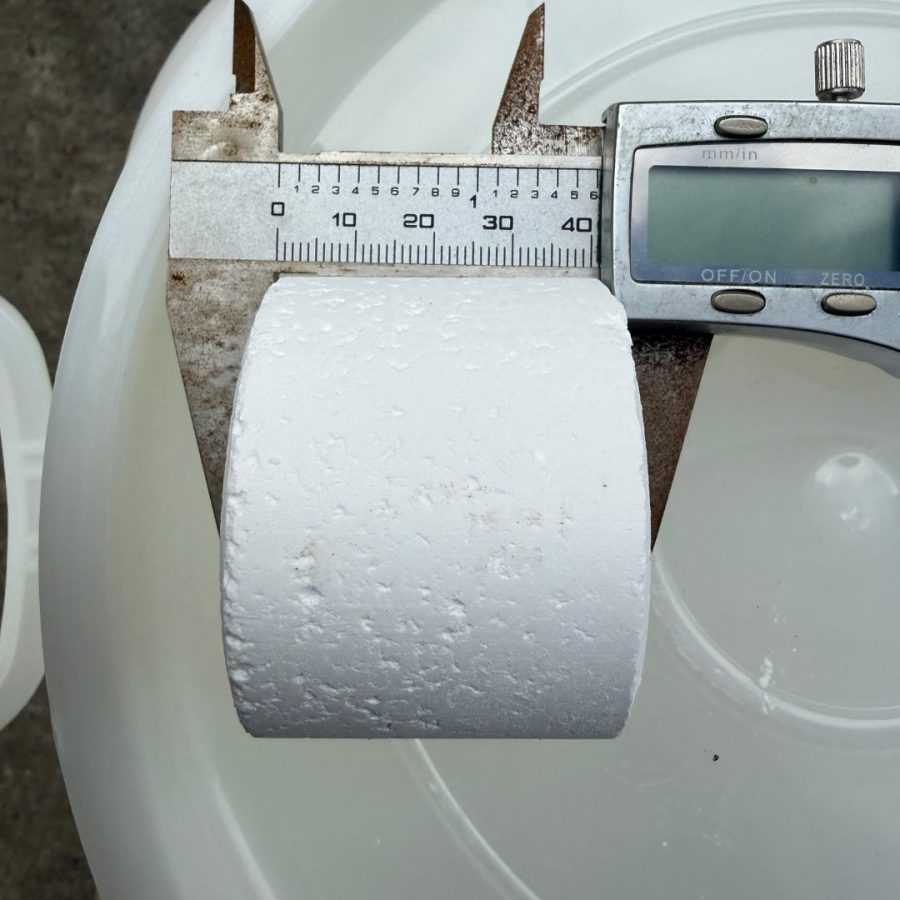
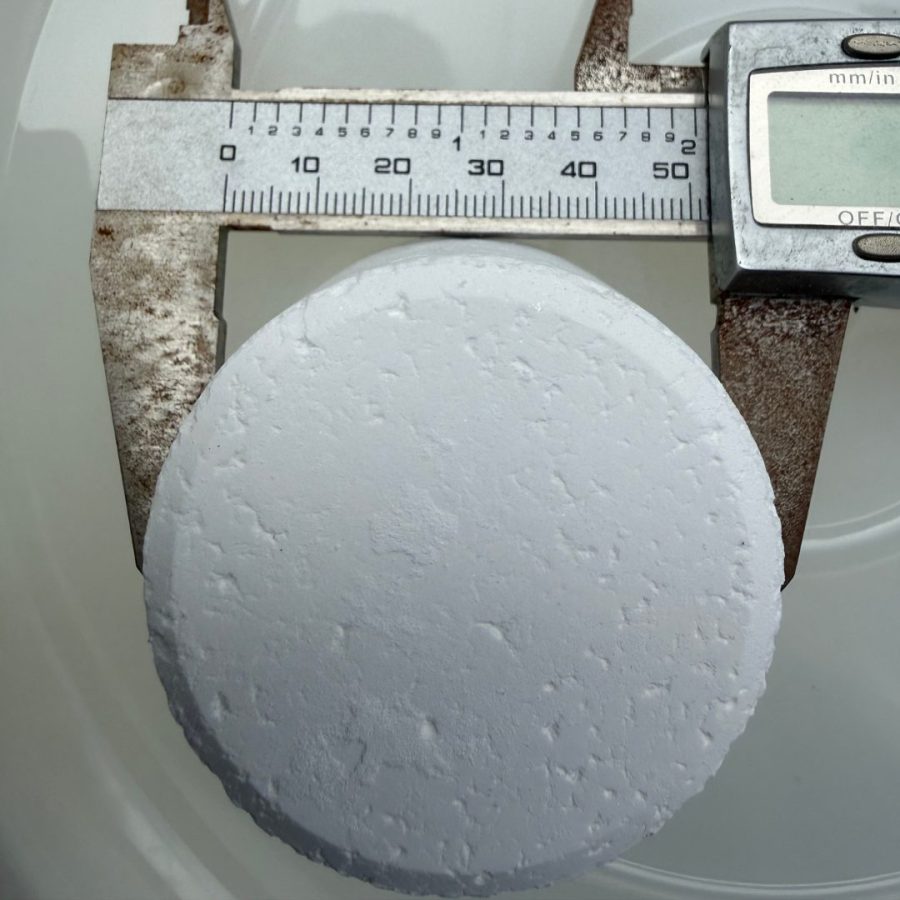
| Tablet dimensions | Height: 41 mm / Diameter: 52 mm / Weight: 150 g |
| Bulk density | Approx. 0.95–1.05 g/cm³ |
| Solubility in water (25°C) | Approx. 1.2 g/100 mL (slow dissolving by design) |
| pH of 1% solution (10 g/L) | Approx. 2.7–3.0 (acidic; solution is corrosive) |
| Melting / decomposition point | Decomposes at approx. 225–230°C; do not expose to heat sources |
| UN number | UN 2468 |
| ADG Class | Class 5.1 — Oxidising Substance; also bears a subsidiary hazard of Class 8 (Corrosive) |
| Packing group | II |
| Proper shipping name | Trichloroisocyanuric acid, dry |
| Container | 25 kg HDPE drum with tamper-evident lid |
Applications & Use Cases
- Cooling towers and evaporative cooling systems: Intermittent or continuous biocidal dosing to control Legionella spp. and general microbial populations in compliance with AS/NZS 3666 and state public health regulations.
- Potable water storage tanks: Shock chlorination and ongoing disinfection of rainwater tanks, rural property water storage, and emergency potable water reserves (check local authority requirements prior to use).
- Irrigation and recycled water systems: Disinfection of treated effluent and Class A/B recycled water distribution systems.
- Septic systems and on-site sewage management: Effluent disinfection prior to irrigation or environmental discharge where a residual chlorine requirement applies.
- Industrial process water: Microbiological control in process water circuits, heat exchangers, and wash-water systems.
- Wastewater treatment: Tertiary disinfection of treated municipal or industrial effluent.
- Aquaculture: Equipment and facility sanitation (not for direct dosing into fish-bearing water without specialist advice).
- Livestock water troughs: Microbiological control in farm water supplies where residual chlorine dosing is required.
- Emergency water disinfection: Humanitarian or disaster response water treatment.
- Surface and equipment sanitation: Food processing plant, facility, and equipment hygiene where a chlorine-based sanitiser is specified.
Dosing Rates & Guidelines
All dosing rates below are indicative and based on standard Australian industry practice. Actual dosing must be determined by site-specific water quality testing, regulatory requirements, and risk assessment. One 150 g stick contains approximately 135 g of available chlorine (90% w/w).
| Application | Target Free Chlorine Residual | Indicative Dosing Rate | Units | Notes |
|---|---|---|---|---|
| Cooling towers — continuous dosing | 0.2–0.5 mg/L free Cl₂ residual at outlet | 0.5–2.0 g available Cl₂ per m³ of circulating water per day | g/m³/day | Must comply with AS/NZS 3666.2 and state health department risk management plans. TCCA adds CYA which may interfere with some residual monitoring methods — validate analytical method. |
| Cooling towers — shock / remedial dosing | 2–5 mg/L free Cl₂ for minimum 1-hour contact time | Approx. 2–5 g available Cl₂ per m³ | g/m³ | As per AS/NZS 3666.3 remedial disinfection procedures. Isolate drift eliminators where required. Record all dosing events. |
| Potable water storage tank — shock chlorination | 5–10 mg/L free Cl₂; allow 30-minute contact time then flush | Approx. 5.5–11 g TCCA per 1,000 L (1 m³) | g/m³ | Pre-dissolve before dosing. Flush thoroughly before returning to service. CYA accumulation must be managed in ongoing treatment. Check local authority requirements. Note: AS/NZS 4020 compliance of feeder equipment required for drinking water contact. |
| Recycled / irrigation water disinfection | 0.5–1.0 mg/L free Cl₂ residual at point of use | 1.0–3.0 g available Cl₂ per m³ | g/m³ | Dosing rate highly dependent on chlorine demand of treated water. Jar testing and residual monitoring recommended prior to commissioning. |
| Wastewater / effluent tertiary disinfection | Meet discharge licence requirements (typically 1–2 mg/L residual after 30-minute CT) | 5–20 g available Cl₂ per m³ (highly variable; depends on BOD/COD of effluent) | g/m³ | Bench-scale chlorine demand testing essential. High organic loads will consume chlorine rapidly. Consider chlorine contact time (CT value) requirements of the relevant environment protection licence. |
| Equipment and surface sanitation (solution) | 50–200 mg/L available Cl₂ in working solution | Dissolve approx. 55–220 mg TCCA per litre of water | mg/L | Prepare fresh each day. Do not use on aluminium, copper or brass surfaces. Minimum 1-minute contact time on clean surfaces. Rinse food-contact surfaces thoroughly after use. |
Dilution Instructions
Important: Trichloroisocyanuric acid is a powerful oxidiser. Always handle in a well-ventilated area. Never add water directly to solid TCCA — always dissolve TCCA into a large volume of clean water. Never mix with other chemicals in concentrate form.
- Don PPE before commencing: Put on chemical-resistant gloves (nitrile minimum 0.4 mm, neoprene or butyl preferred for extended contact), chemical splash goggles, and an apron. If preparing solutions in enclosed spaces or handling quantities greater than 500 g, wear a P2/Class B combination respirator.
- Select appropriate equipment: Use a clean, dry HDPE or polypropylene bucket or dosing vessel. Never use metal containers. Ensure the vessel is free from contamination — even residues of incompatible chemicals (see Chemical Compatibility section) can cause dangerous reactions.
- Fill the vessel with clean, cool water first: Add the required volume of clean water to the vessel before adding any TCCA. Water temperature should ideally be below 25°C. Do not use hot water — this accelerates dissolution and chlorine gas evolution.
- Add TCCA slowly to the water: Place the required number of sticks or weighed quantity of TCCA gently into the water. Never pour water onto dry TCCA tablets. Stir gently with a chemical-resistant paddle or rod.
- Allow to dissolve fully: TCCA sticks are designed to dissolve slowly. For preparing working solutions, allow adequate time for complete dissolution (typically 15–30 minutes for a 150 g stick in 10 litres of water at 20°C). Do not crush sticks to accelerate dissolution unless specifically required — crushing increases dust and chlorine gas hazard.
- Verify concentration before use: Use a calibrated DPD chlorine test kit or photometer to verify free available chlorine (FAC) concentration in the prepared solution before application. Record the result.
- Dose immediately or use within 24 hours: Prepared chlorine solutions degrade rapidly, particularly in sunlight. Store prepared solutions in a sealed, opaque HDPE container and use within 24 hours. Label all prepared solutions with date, time, and concentration.
- Dispose of unused solution correctly: Do not return unused solution to the original drum. Dilute heavily with water and dispose to sewer in accordance with local trade waste regulations, or allow to dechlorinate naturally in an open, ventilated area before disposal.
For in-line erosion feeders and floating dispensers: Load tablets or sticks directly into the feeder per the manufacturer’s instructions. Ensure the feeder is designed for TCCA — not all feeders are compatible. Never mix TCCA sticks with other tablet types (e.g. calcium hypochlorite pucks, bromine tablets) in the same feeder. Never leave a TCCA feeder in a stagnant, non-circulating water system.
| Weight | 28 kg |
|---|---|
| Dimensions | 58 × 25 × 25 cm |
Related products
-
Flocculant – Granular 25Kg / 10Kg / 5Kg
Price range: $35.00 through $75.00 Select options This product has multiple variants. The options may be chosen on the product page -
Citric Acid Anhydrous – Multi-Purpose
Price range: $54.00 through $136.00 Select options This product has multiple variants. The options may be chosen on the product page


